
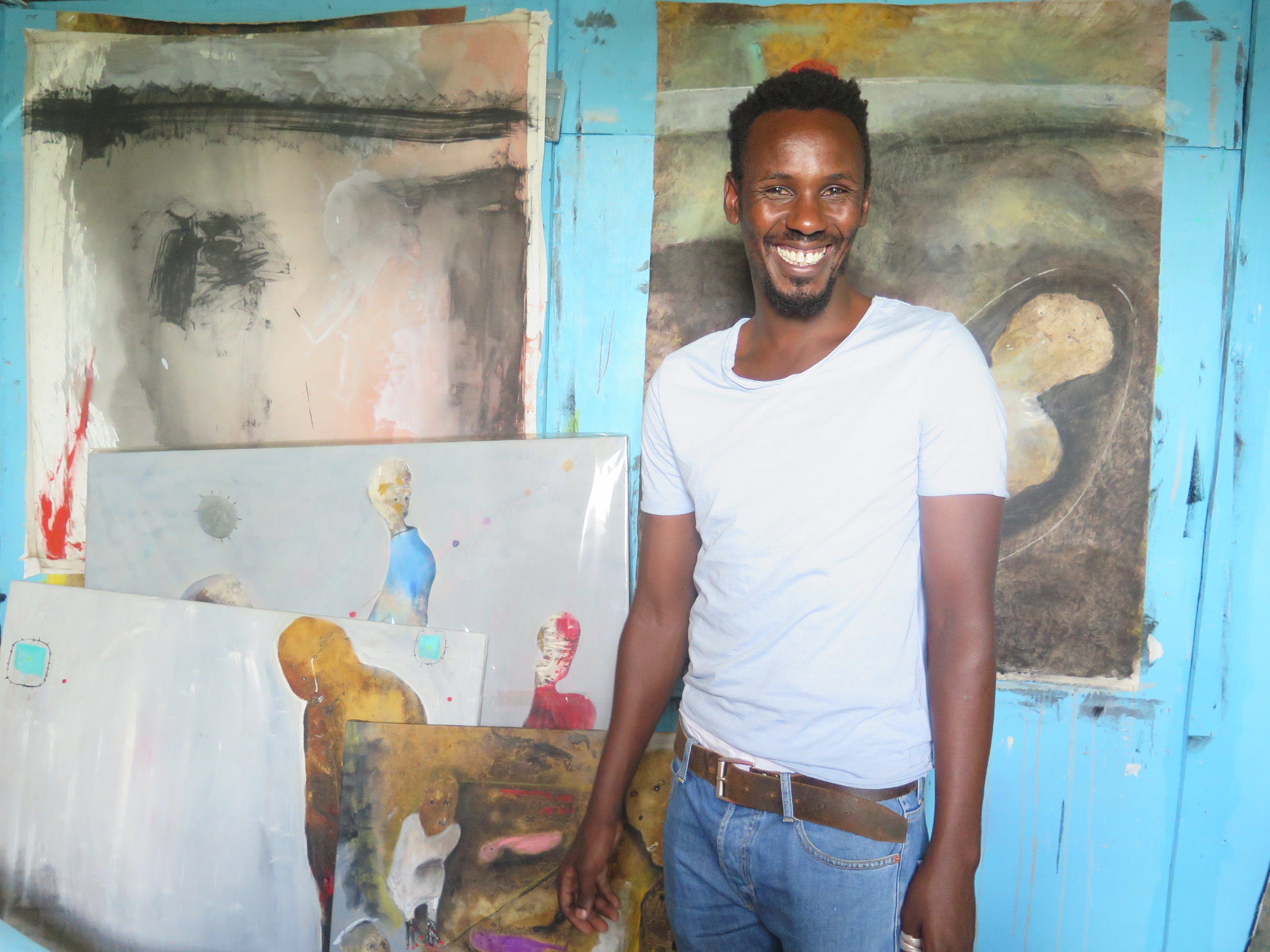
Photo image: Shabu Mwangi
Thank you Shabu for joining me in this episode. Would you tell us a bit about yourself?
So, I’m from Kenya, Nairobi. I’m a visual artist based in the community called Wajuku Mokuru, from a collective called Wajukua Project.
Wajuku is a collective which is made of, like, 15 artists. Five of us are, like, visual artists, and ten of us are more into social programs, where we conduct workshops with kids and also mentorship to the youth who are in the community.
I also do my own project and I’m also a farmer outside Nairobi, where I try to do something to do with nature. So, yeah, that’s a bit of who I am.
Whereabouts is your farm?
Around 150 km away from Nairobi, it’s in Yandara County.
Okay. And you go back and forth?
Like, every two weeks I go to the farm, but my mom, she stays there.
In your village?
In the farm, yeah.
Lovely. Okay, so with this under the radar exhibition here in Geneva, you’re an international artist. Were you an artist in Nairobi as part of Matsa Edgelands?
Matza, when they came to Nairobi, my collective was actually the one that hosted Matza. So we did a collaboration and did the workshop in our community, where at the end, we had to exhibit in the community and so on. So, yeah, I was part of the artist who took part in Matza in Nairobi.
And what drew you to coming here for this exhibition?
To me, the idea behind what Matza and Edgelands are doing, I think, is a very interesting subject. But the time is always very short. So I thought coming to take part in another one, I will grasp something. But there are always dynamics and challenges in every workshop. I think, for example, when I came here, I felt like I knew nothing about Matza and I had to kind of get into the community here and try to at least grasp something to be able to create.
Because despite living in a global world, we are very diverse. And that’s one thing that is hard for you to just assume, you know, what is in Geneva or what is in Nairobi. So I was just like a new guy joining the workshop.
A major theme in this exhibition is security and feeling safe. What does security mean to you?
Security to me is a super complex thing to define just with a few words because it has a lot of dynamics. And when you have two in hand, you have your space and you have security, it’s really very challenging as an artist to come up with a very defined way of seeing it.
When I first came here, when I travel abroad, I’m always under the radar because I’m that subject. I’m the subject matter. Once I leave my country, I know I’m a subject to security and everything from border control, airport control. And me being here, I think I feel more under the radar because I know no one in the community. You need to make a new community. You need to make new friends.
And also my race, like being black in Europe, is not an easy thing. Even if you have documents, there is always this perception that you may be a migrant. There is never a room where that perception will lack. There is always that perception. Not until you speak and say, I’m here for this and this. They say, okay, you are here for this. But there is always this perception also from the community, that you are an immigrant, especially black people. That’s how I see it, because I have traveled before and I have worked before with refugees in Berlin, and I know how in Berlin, in Germany, and I know how it feels.
And as an artist?
As an artist, I was doing a fellowship with EFA.
Okay.
And I worked with refugees and this was 2017. And when I went back, I did a solo exhibition which was called ‘Statelessness Portraits’.
It was visual art as well?
Yeah, it was visual. The institution that hosted me, not like everyone knew I was there for internship because I was under EFA fellowship to learn on how to manage an organization and so on. So I just came very low key. Most of the staff really didn’t know I was there as an intern. I was also seen as one of the refugees. And it was really a cool thing for me to see under those closets what happens.
And when I went back home, I was able to really express how I felt.
Because migration has been my subject since I was young as an artist. And it’s always my subject. And I will never stop because it’s human nature to move. Before everything movement was always there.
Like, I’m a Kenyan, but my father is not from Kenya. So I have this spirit. I don’t know where I belong, but I’m human and I also need safety.
Could you share your experience when you’re back home and with your collective
You know, home is home.
So some of the issues, do we share it here in Geneva, do you think?
Yeah, we live in an informal settlement.
And the feeling is the same. You are not in a permanent space where you can call home. Since I was young, we live in this fear of, you don’t know tomorrow. You don’t know if the government decides today they will demolish the houses because they are informal homes.
So it’s the same feeling. I see refugees with people migrating, coming to the west hoping for better. But the reality that hits sometimes is really bitter.
And to me, back home, I can say I feel really grounded because I have peers, I have friends who we grew up with and dreamt and do a lot with. But when I travel, I always have to find my ground and start interacting with the community because two weeks was a very short time to integrate and to come up with a super research view, point of view.
To do something, but I’m always aware of what’s happening with the system, and this is my expression.
Material wise, it was a challenge, because I don’t know how to maneuver. I don’t know what material I can get.
Can you describe it?
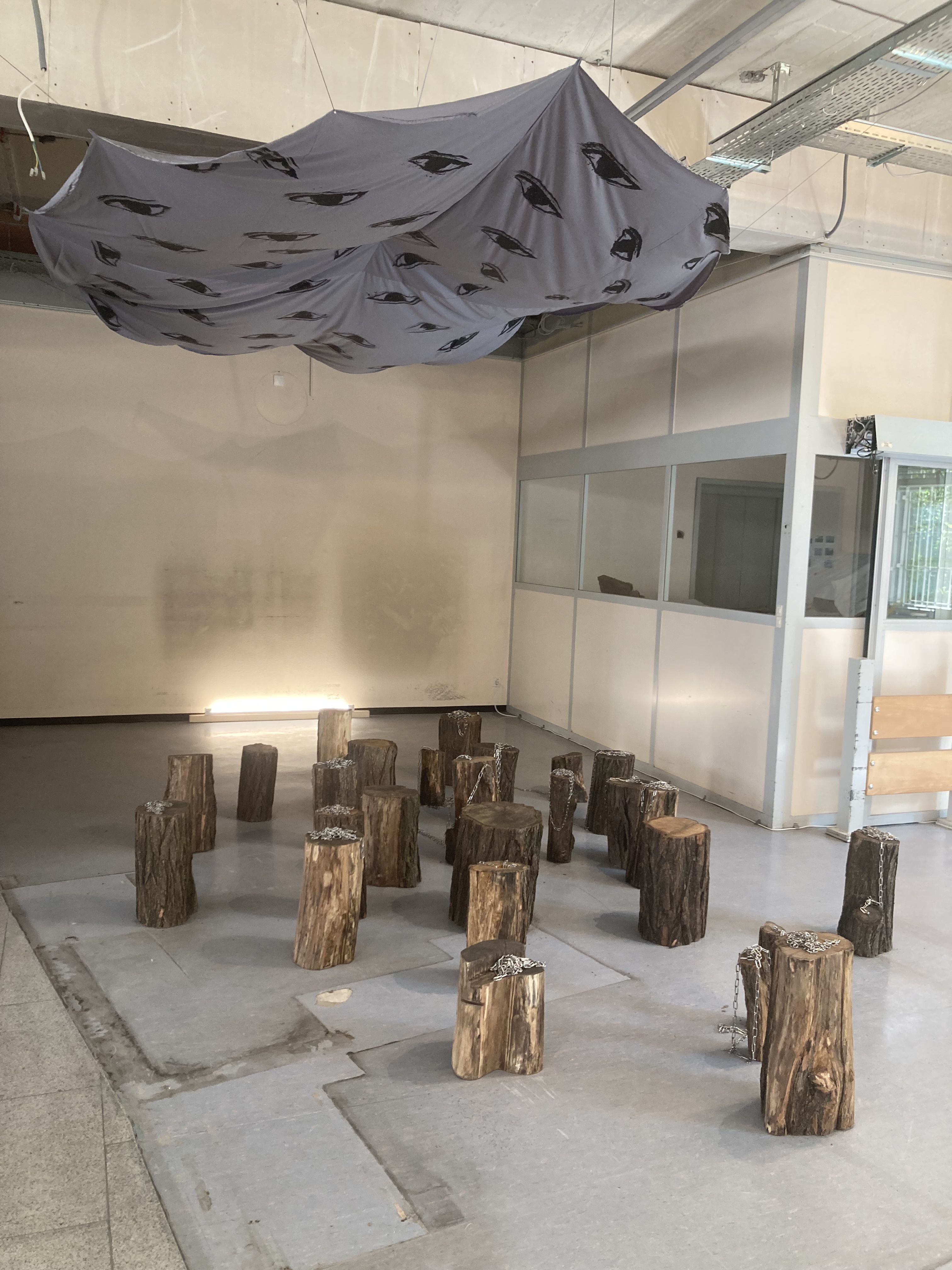
I opted for the natural and easiest material that my eyes can translate what I want to. So there is a concept behind it.
This was over the two weeks?
Yeah. One week was meetings, meeting different people, and this week was to kind of create this art. But there is a small concept about the installation. Maybe I can share with you, and then you can have it written because it’s long.
Okay
But I can share with you. So you get the whole concept of the installation.
Digitalization is having a growing impact on all of our lives, like you mentioned. What impact does digitalization have specifically on your art or any of the themes that you are passionate about?
This security sense of belonging. I think it creates more space in between communities, because digitalization somehow brings an individual. Thinking that you are safe in the system. But I think to me, people are the key security, people are the key safety for freedom.
And digitalization is somehow removing the natural way of people socializing to a point that you become chained to your gadgets. It’s the same concept I’m doing. We are losing communities, and now we are living more into gadgets. And this is all from digitalization. We will forget who we are with time, and then something will take over. This is how I see digitalization. We are losing. We are losing humor, we are losing love, we are losing connection. And we have these spaces where we can meet, but most of the time, we are occupied with our gadgets.
And lastly, with this collective space here being temporary, like you just said, as an international artist, what permanence would you like for there to be here after the exhibition?
In this space?
I think what I would like to remain in the city or in the neighborhood is just for them to reflect on what’s here and carry it with them. Because everything, like you said, is temporary, even this space. So, whatever will be here, whatever will be exhibited I would like the community to embrace it and start thinking of an alternative way of finding a way to be more close.
And this is one way of creating security within ourselves rather than depending on institutions or technology to help.
Thank you.
Thank you.
 Zara Tewolde-Berhan